Density vs. Thickness: What Actually Makes a Hot Tub Cover Strong?
When you are looking for a hot tub cover replacement, it’s easy to get caught up in the numbers. You see terms like "5-inch taper" or "2-pound foam," and suddenly, it feels like you need a degree in engineering just to keep your spa water warm.
Most owners assume that a thicker cover is naturally a stronger cover. But is that always true? If you’ve ever dealt with a waterlogged, heavy cover that sags in the middle, you know that "big" doesn't always mean "durable."
In this guide, we’re breaking down the science of foam density and material properties to help you understand what actually protects your investment.
1. The Great Debate: Thickness vs. Density
Before we dive into the manufacturing process, let's define our two main contenders.
-
Thickness: This is the physical height of the foam insert. Most covers use a "tapered" design (e.g., 5 inches thick at the center sloping to 3 inches at the edges) to allow rain and snow to slide off.
-
Density: This refers to the weight of the foam per cubic foot. It’s about how tightly the molecules are packed together.
Think of it like a loaf of bread versus a brick of the same size. The brick is denser, harder to break, and much better at supporting weight. When you buy a custom hot tub cover, finding the right balance between these two is the secret to longevity.
2. Understanding Foam Density Measurements
In the spa industry, foam density is typically measured in pounds. The most common options are 1.0 lb, 1.5 lb, and 2.0 lb.
-
1.0 lb Density: Standard insulation. It’s lightweight but lacks structural integrity for heavy snow loads.
-
1.5 lb Density: The industry "sweet spot." It offers excellent R-value (insulation power) and significant strength.
-
2.0 lb Density: High-performance foam. This is for extreme climates. It is incredibly rigid and provides the highest level of moisture resistance.
Choosing a higher density is often more important than adding an extra inch of thickness. A 4-inch cover with 2.0 lb foam is frequently stronger and more energy-efficient than a 5-inch cover with 1.0 lb foam.
3. Material Properties: Beyond the Foam
A strong hot tub cover isn't just a block of Styrofoam. To ensure strength comparison against the elements, the foam must be supported by high-quality external materials:
-
Marine-Grade Vinyl: This is your first line of defense. It must be UV-stabilized to prevent cracking under the sun.
-
C-Channel Reinforcement: Every quality foam insert should have a galvanized steel "C-channel" running along the hinge. This prevents the cover from snapping under the weight of snow or a curious pet.
-
Vapor Barrier: This is a plastic wrap around the foam. Without a high-quality, heat-sealed vapor barrier, your foam will eventually absorb water.
4. The Manufacturing Process: How Strength is Built
How a cover is put together determines how long it will last. The process usually follows these steps:
-
Precision Cutting: Using CAD technology, the expanded polystyrene (EPS) foam is cut to the exact dimensions of your spa.
-
Tapering: The foam is shaved at an angle. This is critical for moisture resistance because it prevents water from pooling on top, which is the #1 cause of cover failure.
-
Heat Sealing: The foam core is vacuum-sealed inside a chemically resistant poly-wrapper.
-
Double-Stitching: The vinyl skin is sewn with "back-tacked" stress points to ensure the handles and straps don't rip off over time.
5. Moisture Resistance: The Silent Killer
Why do covers get heavy? It’s called "water absorption." Over time, the steam and chemicals from your spa break down the vapor barrier. Once moisture gets into the foam cells, the thermal insulation drops to zero, and your heating bills skyrocket.
High-density foam (like 2.0 lb) has smaller air pockets, making it much harder for water to penetrate. If you live in a humid area or use your tub daily, investing in a higher density hot tub cover replacement is the best way to fight waterlogging.
6. Strength Comparison: Which One Do You Need?
|
Feature |
Thick (But Low Density) |
Thin (But High Density) |
|
Snow Load |
Likely to sag/crack |
Very rigid; holds weight |
|
Insulation |
Good (due to air space) |
Excellent (tight cells) |
|
Longevity |
2–3 years |
5–7 years |
|
Weight |
Easy to lift initially |
Stays consistent over time |
The Verdict
If you live in a warm climate with no snow, a thicker cover might save you a few dollars on heating. However, if you face wind, rain, snow, or have kids/pets, density is your best friend.
7. Step-by-Step: How to Choose Your Next Cover
-
Measure Your Spa: Don't rely on the manufacturer's manual; measure the actual acrylic rim of your tub.
-
Evaluate Your Climate: Do you get snow? Choose at least 1.5 lb or 2.0 lb density.
-
Check the Hinge: Ensure there is a reinforced C-channel to prevent sagging.
-
Prioritize the Vapor Barrier: Ask for a double-wrapped or 6-mil plastic barrier to maximize moisture resistance.
-
Select UV-Rated Vinyl: Ensure the outer skin can handle the "bake" of the afternoon sun.
Protecting Your Peace of Mind
At the end of the day, a hot tub cover has one job, to keep the heat in and the debris out. While thickness provides the look of protection, foam density and material properties provide the reality of it.
By choosing a custom hot tub cover designed with high-density foam and a tapered manufacturing process, you aren't just buying a lid you’re buying years of energy savings and structural security.
Don't wait until your current cover is too heavy to lift. Upgrade to a hot tub cover replacement that focuses on what actually makes a cover strong.
Custom-Made for a Perfect Fit
Every spa is unique, which is why we don’t believe in "one size fits all." We specialize in custom hot tub covers designed using advanced CAD (Computer-Aided Design) technology. This ensures that every cover is built to your exact dimensions, providing a snug, airtight seal that locks in heat and keeps out debris.
If your current cover is heavy, waterlogged, or cracked, it’s time for a hot tub cover replacement. Our streamlined ordering process makes it easy to upgrade to a handmade, high-performance cover that will restore your spa’s efficiency and aesthetic appeal.

Heavy-Duty Handles
Double-stitched, marine-grade vinyl for maximum durability and a premium look.

Safety Straps
Reinforced, color-matched straps designed to withstand high winds and heavy use.

Reinforced Stitching
Double-stitched seams and hinges to ensure your cover lasts for years.
Other Guys
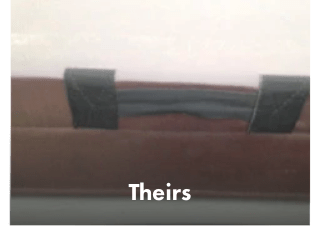
Their cheap handles are more prone to wear and tear and are known to rip off within the first two years plus the appearance speaks for itself.
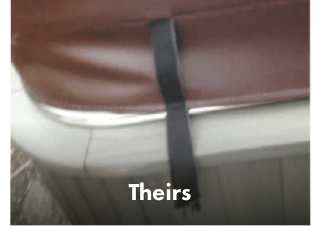
Our competition uses low-quality straps that are prone to breakage and often times do not match the color of the spa cover.

Their use of single stitching and exposed shells can ultimately cause cracking and heat loss, costing you more on your electric bill.
Why Choose MySpaCover?
We don’t just claim to have the best quality, we prove it through superior materials and craftsmanship. Every cover we produce is "Made in the USA" and built to exceed industry standards, ensuring your investment is protected for years to come.
We’ve found a few great alternatives to your selected spa cover that can reach you even quicker!
Here are the closest available alternatives based on your preferences.