Energy-Saving Hot Tub Hacks: Cut Your Bills in Half
Your hot tub should be a source of relaxation, not financial stress. Yet many hot tub owners watch in dismay as their energy bills skyrocket month after month. The good news? With a few strategic changes, you can slash your hot tub operating costs by up to 50% while still enjoying every luxurious soak.
Whether you're a new hot tub owner or a seasoned spa enthusiast, these proven energy-saving hacks will help you keep more money in your pocket without sacrificing comfort.
1. Master the Art of Hot Tub Cover Management
The single biggest energy waster: An improperly used or damaged hot tub cover.
Your hot tub cover isn't just a lid—it's your first line of defense against heat loss. Studies show that up to 70% of heat escapes from an uncovered hot tub surface through evaporation and radiation. A quality, well-maintained cover can reduce your energy costs by up to 50%.
Critical cover tips:
Keep it on when not in use: Every minute your hot tub sits uncovered, heat—and your hard-earned money—literally evaporates into thin air. Make covering your tub second nature after every use.
Let it breathe strategically: While keeping the cover on is crucial, remove it for 1-2 hours weekly on a sunny day to prevent mold and moisture buildup. This also allows harmful chemical fumes to dissipate after shocking.
Check for waterlogging: A waterlogged cover loses its insulating power and can double your heating costs. If your cover feels heavy, sags in the middle, or takes two people to remove, it's time for a replacement.
Invest in a cover lifter: A $200-300 cover lifter pays for itself within months by making it effortless to use your cover correctly every time. No more leaving it half-on or skipping it because it's too heavy.
Want to dive deeper into cover best practices? Read our comprehensive guide on whether you should leave your hot tub cover on all the time for expert insights on maximizing cover efficiency, extending its lifespan, and knowing when it's time for a replacement.
2. Lower Your Temperature (Just a Little)
Here's a shocking truth: Each degree you lower your hot tub temperature saves approximately 10% on heating costs. Dropping from 104°F to 100°F could save you $15-30 per month, depending on your climate and usage.
Smart temperature strategies:
Find your comfort zone: Most people can't tell the difference between 102°F and 104°F. Experiment with slightly lower temperatures—you might discover you prefer 100-102°F, which is still luxuriously warm but significantly cheaper to maintain.
Use vacation mode wisely: If you won't use your hot tub for a week or more, drop the temperature to 95-98°F. Your tub will maintain chemical balance while using 30-40% less energy. Just remember to bump it back up 6-8 hours before your next soak.
Avoid the on/off trap: Contrary to popular belief, turning off your hot tub between uses costs MORE than maintaining a steady lower temperature. Your heater works overtime to reheat cold water, consuming massive amounts of energy.
3. Optimize Your Filtration Cycle
Your circulation pump runs for hours each day, and while it's essential for clean water, it doesn't need to run as much as you think.
Filtration optimization tips:
Reduce cycle time: Most hot tubs default to 8-12 hours of filtration daily, but 4-6 hours is often sufficient for moderately used tubs. Test shorter cycles and monitor water clarity—you might be over-filtering.
Schedule during off-peak hours: If your utility offers time-of-use rates, program filtration for late-night hours when electricity is cheapest. This simple setting change can save $10-20 monthly.
Clean filters regularly: Dirty filters force your pump to work harder, consuming more electricity. Rinse filters weekly and deep-clean monthly with filter cleaner. Replace them every 12-18 months.
4. Add Thermal Blankets for Extra Insulation
Want to supercharge your hot tub's energy efficiency? Use a floating thermal blanket underneath your hard cover. These thin, floating sheets create an additional vapor barrier, preventing heat loss through evaporation.
Why thermal blankets work: They float directly on the water surface, eliminating the air gap where convection occurs. Combined with your hard cover, they can reduce heat loss by an additional 20-30%.
Cost: $30-50. Payback period: 2-4 months in most climates.
5. Windproof Your Hot Tub Area
Wind is the silent energy thief. Even with your cover on, strong winds create a wind-chill effect that pulls heat from your hot tub's shell and cover, forcing your heater to compensate.
Windproofing solutions:
Strategic placement: If possible, position your hot tub in a naturally sheltered area—near a fence, garage wall, or dense landscaping.
Install windbreaks: Privacy screens, lattice panels, or strategically planted shrubs can reduce wind exposure by 50-70%. A $200 privacy screen can save you $15-25 monthly in harsh climates.
Build a gazebo: For serious savings, consider a gazebo or pergola with retractable side panels. This protects from wind, rain, and snow while creating a resort-like atmosphere.
6. Maintain Proper Water Chemistry
You might not connect water chemistry with energy efficiency, but unbalanced water forces your equipment to work harder and can damage your heater, leading to inefficient operation and costly repairs.
Energy-saving chemistry tips:
Test weekly: Keep pH between 7.2-7.8 and alkalinity between 80-120 ppm. Acidic water corrodes heating elements, making them less efficient.
Prevent scale buildup: Hard water creates calcium deposits on your heater, acting as insulation that prevents efficient heat transfer. Use a scale preventer if you have hard water.
Change water quarterly: Fresh water is easier to heat and maintain than water loaded with dissolved solids.
7. Upgrade to an Energy-Efficient Heater
If your hot tub is more than 10 years old, your heater is likely an energy hog. Modern high-efficiency heaters use 20-30% less energy than older models while heating water faster.
Consider:
Heat pump heaters: Use 60-80% less energy than traditional electric heaters. Initial cost: $1,500-3,000. Payback: 2-4 years in warm climates.
Titanium heating elements: More efficient than stainless steel, resist corrosion better, and last longer.
Calculate Your Potential Savings
Let's put this into perspective. The average hot tub costs $30-50 per month to operate. By implementing just the first four hacks on this list, here's what you could save:
• Quality cover maintenance: $15-25/month savings
• Temperature reduction (4°F): $8-12/month savings
• Optimized filtration: $5-10/month savings
• Thermal blanket: $5-8/month savings
Total monthly savings: $33-55
Annual savings: $396-660
That's more than enough to completely offset your hot tub's operating costs—or pay for a spa weekend getaway!
Start Saving Today
You don't need to implement all seven hacks at once. Start with the easiest and most impactful: cover management and temperature optimization. These two changes alone can cut your bills by 30-40%.
Then, gradually add the other strategies as your budget allows. Within 3-6 months, you'll notice a dramatic difference in your energy bills—and you'll be enjoying your hot tub guilt-free.
Custom-Made for a Perfect Fit
Every spa is unique, which is why we don’t believe in "one size fits all." We specialize in custom hot tub covers designed using advanced CAD (Computer-Aided Design) technology. This ensures that every cover is built to your exact dimensions, providing a snug, airtight seal that locks in heat and keeps out debris.
If your current cover is heavy, waterlogged, or cracked, it’s time for a hot tub cover replacement. Our streamlined ordering process makes it easy to upgrade to a handmade, high-performance cover that will restore your spa’s efficiency and aesthetic appeal.

Heavy-Duty Handles
Double-stitched, marine-grade vinyl for maximum durability and a premium look.

Safety Straps
Reinforced, color-matched straps designed to withstand high winds and heavy use.

Reinforced Stitching
Double-stitched seams and hinges to ensure your cover lasts for years.
Other Guys
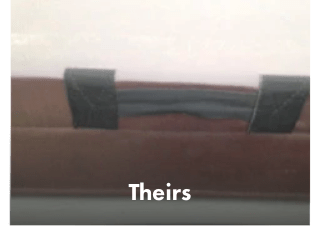
Their cheap handles are more prone to wear and tear and are known to rip off within the first two years plus the appearance speaks for itself.

Our competition uses low-quality straps that are prone to breakage and often times do not match the color of the spa cover.

Their use of single stitching and exposed shells can ultimately cause cracking and heat loss, costing you more on your electric bill.
Why Choose MySpaCover?
We don’t just claim to have the best quality, we prove it through superior materials and craftsmanship. Every cover we produce is "Made in the USA" and built to exceed industry standards, ensuring your investment is protected for years to come.
We’ve found a few great alternatives to your selected spa cover that can reach you even quicker!
Here are the closest available alternatives based on your preferences.