Every Upgrade You Can Get When You Order a Spa Cover from MySpaCover
If you've ever replaced a hot tub cover and thought, "I wish I had known about that option before I ordered," this post is for you.
Most spa owners order a cover the same way they'd buy a replacement light bulb: they pick the size, pick the color, and hit checkout. But a spa cover is one of the hardest-working components your hot tub has. It controls heat retention, blocks UV damage, handles weather loads, keeps water clean, and gets handled multiple times a week. Every time you need a hot tub cover replacement, you have a real opportunity to upgrade the performance, longevity, and ease-of-use of your whole spa setup.
At MySpaCover, we've delivered over 250,000 covers across North America. In that time, we've learned exactly which upgrades make the biggest difference and which ones our customers wish they'd chosen the first time around. Here's a breakdown of every meaningful option available when you order from us, and what each one actually does for your spa.
Why Your Spa Cover Matters More Than You Think
Before we get into upgrades, let's establish why a cover is worth investing in carefully.
Your spa cover sits between your heated water and the outside world 24 hours a day, 7 days a week. On average, a poorly insulated or worn-out cover can increase energy costs by $70 to $80 per year compared to a high-performance replacement. That means a better cover doesn't just protect your spa. It pays for part of itself every single year.
Beyond energy savings, your cover protects your spa shell, your jets, your water chemistry, and your equipment from UV, debris, rain, and temperature swings. A failing cover that lets moisture in or lets heat out accelerates wear across your entire hot tub system.
The good news? When you invest in custom hot tub covers from MySpaCover, every upgrade option is designed around a real performance benefit, not a marketing checkbox.
Upgrade #1: Foam Density - The Single Biggest Performance Decision You'll Make
This is the upgrade that matters most, and the one most spa owners underestimate.
All spa covers use expanded polystyrene (EPS) foam as the insulating core. But not all foam is created equal. The density of the foam, measured in pounds per cubic foot, determines how well it insulates, how long it resists compression, and how effectively it repels moisture over time.
MySpaCover offers five distinct foam density levels, more than any other supplier in North America. That's not a marketing claim. It's a direct result of our commitment to matching the right cover to the right climate and use case.
Here's how to think about which density level you need:
Lighter densities (1.0 to 1.5 lb/ft³) work well in mild climates with moderate temperature variation. They're cost-effective and still offer solid insulation for spas in Southern California, Arizona, or the Gulf Coast.
Mid-range densities (1.5 to 2.0 lb/ft³) are the most popular choice nationwide. They handle four-season climates, resist everyday compression from regular cover removal, and maintain their insulating properties for years without significant foam degradation.
High densities (2.0 lb/ft³ and above) are built for cold climates, high-snowfall areas, or spa owners who want maximum performance and the longest possible cover lifespan. If you're in the Pacific Northwest, the Mountain West, the Upper Midwest, or the Northeast, high-density foam is the smart choice. It resists snow load, stays dry longer, and holds its R-value better over time.
The right foam density is the foundation every other upgrade builds on. Choose it based on where your spa lives, not just what costs less today.
Upgrade #2: Cover Thickness and Taper - Heat Retention You Can Feel
Closely related to foam density is foam thickness. Standard covers come in a tapered profile, typically 4" at the center, tapering to 2" at the edges (written as 4"/2"). The taper serves a practical purpose: it sheds rainwater and snowmelt off the sides rather than pooling in the center, which would add weight and stress the foam core.
At MySpaCover, you can choose from multiple thickness configurations:
4"/2" standard taper is the most common profile, ideal for most climates and budget-conscious buyers who still want solid insulation.
4"/3" reduced taper is a slightly thicker edge profile that improves insulation around the perimeter, where heat loss tends to be highest. A smart upgrade for colder climates.
5"/3" heavy taper is the premium choice for maximum insulation, particularly in climates that see sustained freezing temperatures or heavy snowfall. If you use your spa year-round in a northern climate, this upgrade directly reduces your heating costs.
The combination of density and thickness determines your cover's overall R-value (resistance to heat flow). Higher R-values mean your spa heater cycles less, which means lower electricity bills and less wear on your heating element. For spa owners in cold climates, upgrading both density and thickness can make a measurable difference in monthly operating costs.
Upgrade #3: Marine-Grade Vinyl and UV Protection - What Keeps Your Cover Looking New
The foam core does the heavy insulating work, but the vinyl exterior is what takes the daily punishment: UV radiation, rain, chemical vapors, physical abrasion, and temperature extremes.
All MySpaCover covers use 30 oz.+ marine-grade vinyl as the baseline. This is the same class of vinyl used in marine upholstery applications, where UV resistance and moisture tolerance are non-negotiable. It's substantially heavier and more resistant than the vinyl used in lower-quality covers.
The marine-grade standard matters for a few reasons. Thicker vinyl is more puncture-resistant, resists cracking from UV exposure, and holds its color longer. Thinner vinyl, common in bargain covers, typically begins to crack and fade within two to three years of UV exposure.
For spa owners with outdoor spas in high-UV environments (desert regions, high-altitude locations, areas with long summer days), upgrading to our highest-grade vinyl options provides additional UV inhibitor protection baked into the material.
And because we purchase over 1.2 million yards of marine-grade vinyl annually, our buying volume allows us to source premium materials at a price that still makes the end product competitive. You get high-end materials without the high-end markup.
Upgrade #4: Color Selection - More Than Aesthetics
Choosing your cover color might seem like a purely cosmetic decision, but it has real practical implications.
Darker colors (Coffee Brown, Brazilian Mahogany, Bourbon, Mayan Brown) absorb more solar heat. In cold climates, this can provide a mild passive heating benefit, helping the cover surface warm slightly during sunny winter days. However, darker colors also experience more UV stress over time and may show fading more visibly.
Lighter and neutral colors (Desert Taupe, Oxford Grey, Coastal Grey) reflect more solar radiation. In warm climates or sunny locations, lighter colors reduce heat absorption, which can help prevent overheating of the vinyl surface and extend its lifespan.
Bold options (Sky Blue) offer a distinctive aesthetic for spa owners who want their cover to complement a specific backyard design.
MySpaCover offers a wide range of color options, all available in marine-grade vinyl. When you browse our custom hot tub covers, you can match your spa area's existing color palette while making a choice that aligns with your climate. Visit our spa colors page to view the full selection.
Upgrade #5: Heat Seal - The Underrated Energy Saver
The heat seal (sometimes called a vapor barrier) is one of the most effective and most overlooked upgrades available.
Here's the problem it solves: hot tub water naturally produces steam and chemical vapors. When those vapors rise and contact the underside of your cover, they can slowly penetrate the foam over time. Once moisture gets into the foam core, it becomes heavier, loses its insulating properties, and the cover begins its decline.
A heat seal is a thermal barrier applied to the underside of the cover that dramatically slows moisture penetration. It acts as a vapor retarder between the warm, humid spa environment and the foam core.
The heat seal doesn't just extend the life of your foam. It actively preserves insulation performance over the full life of the cover. A cover with a heat seal will insulate just as well in year four or five as it did when it was new. A cover without one may begin showing degraded performance after two to three years in heavy-use environments.
This is one upgrade we particularly recommend for spas used daily or near-daily, indoor spas or spa rooms where vapor doesn't dissipate, spas in humid climates, and spa owners who use high volumes of chemicals (bromine or chlorine) regularly.
At MySpaCover, we've had customers specifically mention the heat seal as the reason their replacement cover has outperformed their previous one. It's a small cost addition with a disproportionate payoff in longevity.
Upgrade #6: Cover Size and Shape Getting the Fit Exactly Right
This is less of an optional upgrade and more of a core requirement, but it's worth addressing because getting the size right is where many DIY cover orders go wrong.
Every hot tub has a slightly different geometry. The nominal dimensions on the manufacturer's spec sheet are a starting point, not the final measurement. Actual spa shells vary by a few inches depending on manufacturing tolerances, cabinet styles, and whether the spa has been modified over time.
At MySpaCover, we use advanced CAD (Computer-Aided Design) technology to build covers to exact millimeter specifications. Our covers are available in Rounded Rectangle (the most common spa shape), Square, Circle, One Cut Corner, Octagon, and Oversized and Custom Shapes for unusual or non-standard configurations.
For branded spas, we maintain exact specifications for over 40 major spa manufacturers, from Hot Spring and Jacuzzi to Bullfrog, Caldera, Sundance, and beyond. When you shop by brand, you're getting factory-spec dimensions verified against the original manufacturer's specifications.
A cover that fits correctly creates an airtight seal that locks in heat. A cover that's even slightly too small or too large loses that seal and compromises insulation performance at the edges, exactly where heat loss is already highest.
Upgrade #7: Safety Straps and Wind Straps - Security That Matters
Standard covers include basic safety straps that secure the cover to the spa cabinet. But not all straps are built the same.
MySpaCover covers feature reinforced, color-matched straps designed to withstand high winds and repeated daily use. Color matching isn't cosmetic. Straps that contrast visually with your cover show wear earlier because the color difference makes fading more obvious.
For spa owners in exposed locations (rooftop patios, elevated decks, open backyards in windy regions), wind strap upgrades provide additional securing points that prevent covers from lifting or shifting during storms. A cover that blows open or off in a storm can crack, tear, or be damaged beyond repair. Wind straps are cheap insurance.
Safety straps also provide a basic layer of protection for homes with young children or pets, preventing unsupervised access to the spa.
Upgrade #8: Heavy-Duty Handles - The Detail That Breaks on Cheap Covers
If there's one accessory detail that separates a well-built cover from a budget one, it's the handles.
On lower-quality covers, handles are typically thin fabric loops attached with minimal stitching. They begin fraying within the first year of regular use and often tear completely within two to three years, right in the middle of a cover's useful lifespan.
MySpaCover handles are double-stitched, marine-grade vinyl loops built to the same durability standard as the rest of the cover. They're designed to withstand the mechanical stress of daily lifting without delaminating, fraying, or tearing at the attachment points.
This matters especially if you're also using a cover lifter. The handles become load-bearing components in a lifter system, and weak handles will fail faster under repeated mechanical lifting.
Upgrade #9: Skirt Length - A Small Spec That Affects Insulation
The skirt is the fabric apron that hangs down around the perimeter of the cover, sitting between the cover and the spa cabinet.
A longer skirt creates a better thermal seal around the rim of the spa. Cold air infiltration at the cover edge is one of the most common sources of heat loss that doesn't show up in foam density calculations. A longer skirt mitigates this by reducing the gap between the cover and the cabinet.
For spas positioned in cold or drafty locations (against exterior walls, in exposed areas, or in climates with frequent cold winds), upgrading to a longer skirt is a cost-effective way to improve edge insulation without paying for denser foam throughout.
Upgrade #10: Locking Strap and Key Lock - Safety and Peace of Mind
For households with children, the locking strap upgrade provides an additional layer of safety beyond standard securing straps.
Locking straps include a key lock mechanism that prevents the cover from being lifted without the key. This is particularly valuable for families with young children, neighborhoods with community or shared access, or for vacation properties where the spa is unattended for periods.
The Consumer Product Safety Commission (CPSC) recommends multiple layers of access prevention for residential spas, and a locking cover strap is one of the most direct and affordable options available.
How to Choose the Right Combination of Upgrades
The smartest approach to upgrading your spa cover is to think about your specific use case, not just the base specs.
For year-round spa users in cold climates: Prioritize high-density foam, maximum taper thickness (5"/3"), the heat seal upgrade, and reinforced straps. The energy savings from better insulation will be your biggest return on investment.
For spa owners in hot, sunny climates: Prioritize UV-resistant vinyl, lighter colors, and standard foam density. Your cover faces more UV stress than thermal stress, so material durability is the priority.
For heavy daily users: Add the heat seal to extend foam lifespan, invest in heavy-duty handles, and consider the longer skirt for a more complete edge seal.
For spa owners with children or shared access: Add locking straps for safety. No other upgrade matters more from a protection standpoint.
For spa owners replacing a waterlogged or sagging cover: The cover failed primarily from moisture infiltration. When you replace it, add the heat seal and upgrade your foam density to prevent the same failure pattern from repeating.
Why MySpaCover for Your Upgrade?
We're one of North America's largest spa cover suppliers, and we've built that position by doing a few things consistently well.
We use better materials. Over 1.2 million yards of marine-grade vinyl purchased annually. Closed-cell EPS foam in five density options. Double-stitched seams and handles throughout.
We build to exact specs. Every cover is manufactured using advanced CAD technology matched to your spa's exact dimensions, not close enough, but precisely right.
We back our work. Our industry-leading 5-year warranty covers defects in materials and craftsmanship. Less than 1% of our customers ever file a warranty claim. That's not luck. That's what high-quality materials and skilled craftsmanship produce.
We ship free. Free shipping to all US addresses, with regular updates from order to delivery.
Our customers actually tell us it works. We've had customers describe covers that fit like a glove, note how much lighter new covers feel compared to their waterlogged old ones, and comment on the noticeable improvement in spa temperature maintenance.
Ready to Order?
Every option described in this post is available when you configure your order. Start by choosing your spa's shape or searching by brand, then work through your configuration options with our team or our online ordering system.
Browse the full selection of custom hot tub covers and configure the combination of upgrades that fits your spa, your climate, and your priorities.
Have questions about which options are right for your specific setup? Call us at (800) 979-2984, Monday through Friday, 7am to 5pm PST. Our team has helped hundreds of thousands of spa owners find the right cover. We're ready to help you find yours.
Custom-Made for a Perfect Fit
Every spa is unique, which is why we don’t believe in "one size fits all." We specialize in custom hot tub covers designed using advanced CAD (Computer-Aided Design) technology. This ensures that every cover is built to your exact dimensions, providing a snug, airtight seal that locks in heat and keeps out debris.
If your current cover is heavy, waterlogged, or cracked, it’s time for a hot tub cover replacement. Our streamlined ordering process makes it easy to upgrade to a handmade, high-performance cover that will restore your spa’s efficiency and aesthetic appeal.

Heavy-Duty Handles
Double-stitched, marine-grade vinyl for maximum durability and a premium look.

Safety Straps
Reinforced, color-matched straps designed to withstand high winds and heavy use.

Reinforced Stitching
Double-stitched seams and hinges to ensure your cover lasts for years.
Other Guys
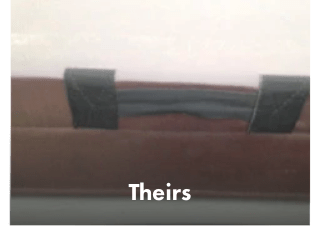
Their cheap handles are more prone to wear and tear and are known to rip off within the first two years plus the appearance speaks for itself.
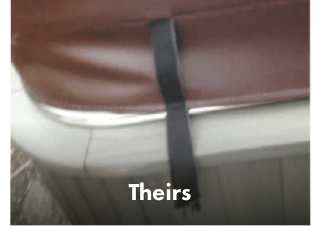
Our competition uses low-quality straps that are prone to breakage and often times do not match the color of the spa cover.

Their use of single stitching and exposed shells can ultimately cause cracking and heat loss, costing you more on your electric bill.
Why Choose MySpaCover?
We don’t just claim to have the best quality, we prove it through superior materials and craftsmanship. Every cover we produce is "Made in the USA" and built to exceed industry standards, ensuring your investment is protected for years to come.
We’ve found a few great alternatives to your selected spa cover that can reach you even quicker!
Here are the closest available alternatives based on your preferences.